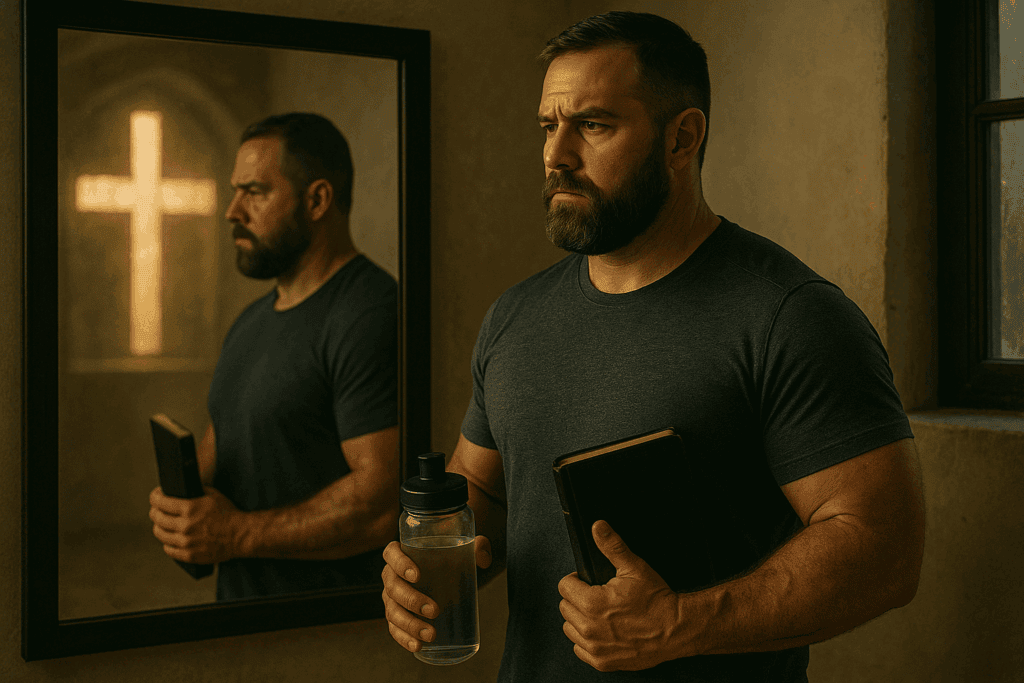
Most men think walking is easy. But the truth is, walking is obedience in motion. It’s where your spirit and your steps start to line up.
When I began walking daily, I thought I was just burning calories. But God was burning away pride, fear, and distraction. Step after step, He taught me to slow down and listen. I started hearing Him again — not in a church building, but on quiet roads at sunrise.
That’s when I realized something powerful: The way you treat your body reflects how you walk with God.
If you’re too tired to pray, too stressed to think, too heavy to move, something’s off. You weren’t designed to drift through life exhausted and disconnected. You were created to walk with God — spiritually, mentally, and physically.
When Enoch walked with God, he didn’t sprint. He didn’t chase comfort or status. He moved faithfully, one step at a time, in rhythm with the Lord.
“Enoch walked faithfully with God; then he was no more, because God took him away.” — Genesis 5:24 (NIV)
That’s what walking with God really looks like — a life of steady obedience, not perfection. And that’s exactly what daily walking can teach you.
Because the same discipline that gets you out the door builds your faith inside your heart. The same breath you use for cardio becomes your prayer in motion.
This isn’t about hitting 10,000 steps. It’s about becoming the kind of man who moves when God says move.
But before you can walk with God, you have to face why you stopped. Let’s talk about why so many men today feel spiritually distant and physically drained.
Why Most Men Feel Spiritually Distant and Physically Drained
Mornings hit hard. The alarm blares. Eyes open, but the soul still sleeps.
Phones get picked up before Bibles. Emails and stress pile on before breakfast. Thoughts race faster than the heart can keep up. Promises get pushed to “later.” Prayer waits. Exercise waits. Life keeps speeding up while faith slows down.
The result isn’t laziness — it’s disconnection.
A man cut off from his body, his purpose, and his God.
The Bible doesn’t label it burnout. It calls it lukewarm.
“I know your deeds, that you are neither cold nor hot. I wish you were either one or the other! So, because you are lukewarm—neither hot nor cold—I am about to spit you out of my mouth.” — Revelation 3:15–16 (NIV)
That verse hit me like a punch to the gut. It described everything I’d become — busy but empty, moving fast but going nowhere. The weights I lifted couldn’t fix the weight I carried inside.
When a man stops walking with God, everything starts slipping. Energy fades. Focus scatters. Patience thins. His reflection becomes a picture of his spiritual drift — softer body, heavier mind, colder heart.
It never happens overnight. Small choices stack quietly.
Fast food replaces real fuel.
Screens replace Scripture.
Comfort replaces conviction.
But Isaiah offers hope for the weary:
“Even youths grow tired and weary, and young men stumble and fall; but those who hope in the Lord will renew their strength.
They will soar on wings like eagles; they will run and not grow weary, they will walk and not be faint.” — Isaiah 40:30–31 (NIV)
Renewal starts with a step. Not a sprint, not a plan — a step.
Movement resets momentum. Obedience restores fire. Strength follows surrender.
No supplement or self-help trick can replace a daily walk with God. Only He can fill what’s been running on empty. Let’s look at what it truly means to walk with God — not as an idea, but as a way of living every step with Him.
What It Really Means to “Walk with God”
Walking with God isn’t a feeling. It’s a lifestyle of alignment — where your choices, thoughts, and actions move in rhythm with His will.
Enoch didn’t clock miles on a treadmill. He lived in step with God’s heart. His faith shaped every decision. His obedience spoke louder than any sermon.
“Enoch walked faithfully with God; then he was no more, because God took him away.” — Genesis 5:24 (NIV)
Noah did the same. When the world mocked him, he kept walking. His feet followed faith when everyone else followed fear.
“Noah was a righteous man, blameless among the people of his time, and he walked faithfully with God.” — Genesis 6:9 (NIV)
Both men modeled the same truth — walking with God means trusting Him when it’s inconvenient, unpopular, or unclear.
The Hebrew word for walk here means to go continually, to follow closely, to live in constant movement with. That’s not Sunday religion. That’s daily discipline. It’s choosing faith in traffic, prayer during stress, humility in conflict, and truth when temptation calls.
Micah captures it perfectly:
“He has shown you, O mortal, what is good. And what does the Lord require of you?
To act justly and to love mercy and to walk humbly with your God.” — Micah 6:8 (NIV)
This isn’t about perfection. God doesn’t expect flawless strides — He wants faithful ones.
A humble walk beats a loud talk every time.
When I started living like this, everything changed. My workouts turned into worship. My cardio became communion. The more I walked physically, the more I began walking spiritually — one step, one prayer, one breath at a time.
Every step became a reminder: obedience isn’t about speed; it’s about direction. Now that we know what walking with God means, it’s time to see why physical walking matters too — because your body is part of your worship.
Why Physical Walking Matters to God Too
God created your body for more than comfort. He designed it for movement, discipline, and worship. Every heartbeat, breath, and step is a gift meant to be used — not wasted.
Most men treat fitness like a chore. They forget the body isn’t theirs. It belongs to God.
“Do you not know that your bodies are temples of the Holy Spirit, who is in you, whom you have received from God? You are not your own; you were bought at a price.
Therefore honor God with your bodies.” — 1 Corinthians 6:19–20 (NIV)
That verse flipped the switch for me. Training stopped being about abs or pride. It became stewardship. When I move, I’m caring for something sacred. When I walk, I’m using the body God loaned me to glorify Him.
Walking might seem small, but it’s powerful. It clears the mind, reduces stress, and restores energy. Studies from the American Council on Exercise (ACE) show that just 30 minutes of walking a day can improve cardiovascular health, lower blood pressure, and increase fat metabolism (ACE, Health Benefits of Walking, 2022).
Science proves what Scripture’s been saying all along: movement honors design.
Paul said it this way:
“Therefore, I urge you, brothers and sisters, in view of God’s mercy, to offer your bodies as a living sacrifice, holy and pleasing to God—this is your true and proper worship.” — Romans 12:1 (NIV)
God doesn’t need your six-pack. He wants your surrender. But when you give Him your discipline, your health follows. Movement trains obedience. Stillness without purpose trains apathy. When your body moves, your spirit follows — because motion creates momentum, and momentum builds faith.
You’ve seen how walking honors God physically. Now let’s look at what happens inside your brain and spirit when you move — the science behind why walking actually transforms your mood, focus, and faith.
The Science of Walking — How Movement Transforms Your Mind and Mood
Walking isn’t just good for your heart — it rewires your brain.
Each step sends fresh oxygen to your mind, lowers cortisol, and boosts dopamine. Your mood lifts. Anxiety fades. Focus sharpens. God built your body to respond to motion.
Modern research backs it up.
A PubMed study (Journal of Affective Disorders, 2020) found that just 30 minutes of brisk walking reduces symptoms of depression as effectively as some medications — without the side effects. Another Journal of Physiology (2019) report showed that consistent walking improves memory, cognitive function, and long-term brain health.
Science confirms what Scripture already taught. Movement renews the mind.
“Do not be anxious about anything, but in every situation, by prayer and petition, with thanksgiving, present your requests to God.
And the peace of God, which transcends all understanding, will guard your hearts and your minds in Christ Jesus.” — Philippians 4:6–7 (NIV)
When I walk, that peace shows up. My thoughts slow down. My breathing steadies. Problems shrink. God feels near. The same ground that wears out my shoes restores my soul.
Even Paul tied faith and fitness together:
“For physical training is of some value, but godliness has value for all things, holding promise for both the present life and the life to come.” — 1 Timothy 4:8 (NIV)
Physical discipline doesn’t replace spiritual growth — it strengthens it.
When your body learns consistency, your spirit learns perseverance.
I used to chase energy drinks to feel alive. Now, I just walk. It’s cheaper, cleaner, and way more powerful.
Stress, guilt, shame — they don’t survive long under sunlight and prayer. Now that you’ve seen how movement heals the mind, let’s talk about how obedience fuels the spirit — because walking with God isn’t just about steps; it’s about surrender.
Obedience in Motion — How Daily Walking Trains Your Spirit
Faith doesn’t grow in comfort. It grows in motion.
Every step you take when you don’t feel like it is an act of obedience.
Abraham understood this. God told him to leave everything familiar — no map, no guarantee, just trust.
“By faith Abraham, when called to go to a place he would later receive as his inheritance, obeyed and went, even though he did not know where he was going.” — Hebrews 11:8 (NIV)
Obedience rarely feels convenient. You are going to be tired sometimes. Sometimes your body aches. You might feel like your prayers feel like they’re bouncing off the ceiling. But the test isn’t how you feel — it’s whether you move.
James says it plainly:
“Faith by itself, if it is not accompanied by action, is dead.” — James 2:17 (NIV)
That verse hits hard when your shoes are still by the door. Obedience turns belief into movement.
That’s why I call walking a form of spiritual resistance. The world trains men to chase comfort and avoid pain. God trains men to pursue obedience and build endurance.
Paul captured that battle perfectly:
“Since we live by the Spirit, let us keep in step with the Spirit.” — Galatians 5:25 (NIV)
Walking teaches rhythm — not perfection, but consistency. One foot in front of the other. One day at a time. One prayer per step.
On hard days, I whisper, “Lord, I’m still walking.” That’s all He needs. Faith doesn’t need fireworks. It needs footsteps. Let’s get practical. Here’s exactly how I started walking daily — and how you can turn every step into spiritual and physical growth.
My Daily Walk — How I Combined Cardio and Communion with God
My transformation didn’t start in the gym. It started on the sidewalk.
I used to treat walking like background noise — something you do to burn a few calories between real workouts. But when I began walking with purpose, everything changed. The noise in my head got quiet. My spirit got stronger. My body started responding.
Each morning, I lace up my shoes before sunrise. No music, no podcasts, just prayer and pavement. For the first ten minutes, I focus on breathing and gratitude. By minute fifteen, I start praying for my wife and kids. By the halfway point, I’m listening — not talking. That’s when God usually speaks. Not with thunder, but with conviction.
“The Lord makes firm the steps of the one who delights in him.” — Psalm 37:23 (NIV)
That verse became my anchor. Every time my legs felt heavy, I reminded myself — God was guiding the steps I was taking.
Some days, I bring my Bible app and listen to a chapter while walking. Other days, I just walk in silence. Some days I’ve cried. I’ve confessed, praised, and/or laughed. You get the idea. Its all about real communion — movement and intimacy wrapped together.
“Remain in me, as I also remain in you. No branch can bear fruit by itself; it must remain in the vine.
Neither can you bear fruit unless you remain in me.” — John 15:4 (NIV)
The more I stayed consistent, the more fruit showed up — patience, energy, peace, even fat loss.
Not because I found the perfect fitness plan, but because I found rhythm with God.
Now, when I walk, it’s not about burning calories. It’s about burning excuses.
Every step builds a stronger body and a softer heart. Now it’s your turn. Let’s build a simple plan to help you start walking with God — both spiritually and physically — beginning today.
How to Start Walking with God (Spiritually and Physically)
Transformation starts simple: one step.
No fancy program. No perfect gear. Just obedience in motion.
Here’s the plan I give every man who joins me — the same one that rebuilt my body and faith.
Step 1: Schedule Your Walk with God
Pick a time and make it sacred. Early morning works best. It sets the tone for the day and keeps distractions away.
“Have I not commanded you? Be strong and courageous. Do not be afraid; do not be discouraged, for the Lord your God will be with you wherever you go.” — Joshua 1:9 (NIV)
Treat it like a meeting with the King — because that’s exactly what it is.
Step 2: Walk 40 Minutes a Day
Start small if you need to. Ten minutes in the morning, ten at lunch, twenty after dinner. The goal isn’t perfection — it’s consistency.
Research from the NASM (Walking for Weight Loss and Cardiovascular Health, 2021) found that 40 minutes of walking can lower body fat, improve heart health, and balance blood sugar.
God built the body to thrive on movement.
Step 3: Walk with Purpose
Some walks are for prayer. Others for listening. Others just for gratitude. Let God decide what kind of walk it is that day.
When distractions creep in, remember Isaiah’s promise:
“Whether you turn to the right or to the left, your ears will hear a voice behind you, saying, ‘This is the way; walk in it.’” — Isaiah 30:21 (NIV)
That’s not a metaphor — that’s the Holy Spirit guiding your direction.
Step 4: Pair Your Physical Walk with a Spiritual One
Open your Bible before or after your walk. Read one chapter, then walk it out.
If you read Colossians 2:6–7, live it that day:
“So then, just as you received Christ Jesus as Lord, continue to live your lives in him, rooted and built up in him, strengthened in the faith as you were taught, and overflowing with thankfulness.” — Colossians 2:6–7 (NIV)
Root yourself in God’s truth before you step into the world’s noise.
Step 5: Track Your Progress
Keep a log — not for pride, but for perspective. Note your miles, weight, and prayers answered.
The data builds discipline. The discipline builds faith.
Every day you walk, you prove something to yourself:
You’re not the same man who quit before. You’re moving forward with God.
Now imagine what happens when you keep that walk going — not for a week, but for months. Let’s talk about the transformation that comes when you walk with God consistently.
What Happens When You Walk with God Consistently
Something shifts when you walk with God every day. Your body changes, yes — but your soul changes more.
At first, it feels slow. You fight excuses, battle fatigue, wrestle thoughts. Then, somewhere between mile two and three, peace shows up. The fog lifts. The stress melts. The same ground that once felt like punishment starts to feel like freedom.
God rewards consistency. He honors faithfulness over hype. The longer you walk with Him, the clearer His direction becomes.
“Trust in the Lord with all your heart and lean not on your own understanding; in all your ways submit to him, and he will make your paths straight.” — Proverbs 3:5–6 (NIV)
Straight paths don’t mean easy ones. They mean aligned ones.
Each step starts carrying spiritual weight. Discipline in your body creates discipline in your mind.
When you stay the course, fruit shows up:
“But the fruit of the Spirit is love, joy, peace, forbearance, kindness, goodness, faithfulness, gentleness and self-control.
Against such things there is no law.” — Galatians 5:22–23 (NIV)
That’s the real transformation. Fat loss is just the bonus.
I’ve seen it over and over — men who walk with God become different men. They handle stress better, stop snapping at their wives, lead their homes again. They look their kids in the eye with confidence.
No supplement can give you that. No shortcut can replace it. You can’t outsource a walk with God. You have to show up.
Every day you step out that door, heaven notices. Before we close, let’s make it simple. Here are the biggest lessons walking with God has taught me — truths you can apply starting today.
What I’ve Learned from Walking with God
Years of walking have taught me more than any book or podcast ever could. Movement clears noise. Stillness invites wisdom. God uses the simplest things to teach the deepest lessons.
Here’s what I’ve learned — and what I pray you remember every time you lace up your shoes.
1. Small Steps Beat Big Bursts
Transformation isn’t built in one dramatic moment. It’s built in quiet, repeated obedience. Ten faithful minutes a day will do more for your body and soul than one big emotional burst that fades by Monday.
2. Motion Strengthens Faith
Physical movement fuels spiritual endurance. The more I walk, the easier it becomes to trust God in harder areas of life. When my legs want to quit but I keep moving, my faith grows stronger too.
3. Silence Is Sacred
God doesn’t compete with noise. He speaks in stillness. Walking gives space for His voice to rise above the chaos. I’ve heard more clarity in motion than in a thousand sermons.
4. Consistency Beats Intensity
Missed days don’t matter as much as showing back up. Faithfulness is the real progress. Your body changes because of repetition; your soul changes the same way.
5. Discipline Is Devotion
Every step says, “God, You’re worth it.” You’re not just walking — you’re worshiping. Obedience always outlasts motivation.
Each of these truths came from the same place: the road, my breath, and God’s presence.
Walking taught me patience. It broke my pride. It built my faith.
If you feel stuck, start walking. God moves with those who move toward Him. If you’re ready to take that first step — both spiritually and physically — here’s your next move.
The Challenge — Walk 10 Days with God
You’ve read the truth. You’ve felt the pull. Now it’s time to move.
Ten days. That’s all it takes to start momentum — physically, mentally, and spiritually.
For the next ten days, I want you to walk with God on purpose. Not for steps. Not for weight loss. For worship.
Here’s how it works:
Day 1–3:
Walk 20–30 minutes. Talk to God the entire time. Tell Him where you’re struggling. Ask for direction.
Day 4–6:
Bump it to 40 minutes. No music. Just your breath and the Word. Read one verse before you start and repeat it as you walk.
“Your word is a lamp for my feet, a light on my path.” — Psalm 119:105 (NIV)
Day 7–10:
Walk 40–60 minutes. Mix prayer, gratitude, and silence. Reflect on how your body feels and what your spirit’s learning.
Write down what changes. You’ll notice the difference before anyone else does.
If you want to go deeper, join me in the 10-Day Daniel Fast Challenge — a reset that cleans your diet, renews your discipline, and restores your faith. You’ll learn to eat biblically, move daily, and walk with God like never before.
This isn’t just a fitness challenge. It’s a faith challenge. One that builds momentum in the body and revival in the heart.
You were designed to move with God — not drift from Him.
So lace up. Step out. Start walking.
Ten days from now, you won’t just feel lighter. You’ll feel alive again.