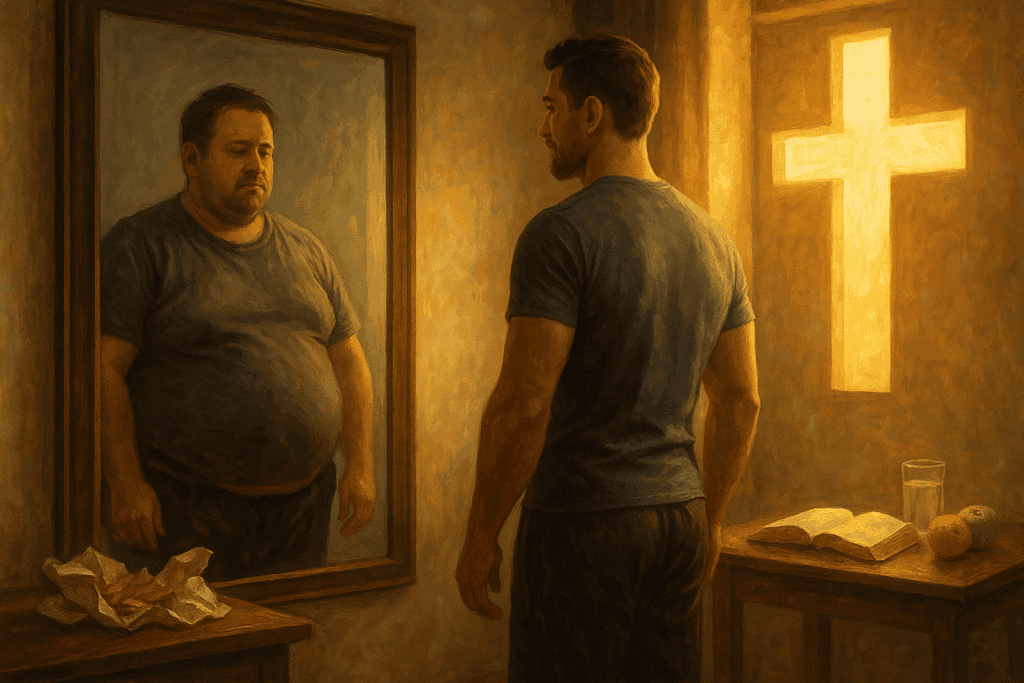
You mute the TV after the news and the noise doesn’t stop. It just moves inside your head. You know your body is a temple, and you still hit the drive-through Monday night without deciding to. You’ve prayed about the same short temper for two years and you still snapped at your kid this morning. In every case, the fight was already lost before you did anything. It was lost in your mind, before your hands or your mouth ever moved.
Renewing your mind is the command in Romans 12:2 to actively replace the thought patterns the world trained into you with thought patterns shaped by God’s truth — not through willpower or positive thinking, but through an ongoing, cooperative process the Holy Spirit starts and you carry out one thought at a time. Real neuroscience confirms the mechanism: the brain physically restructures itself around whatever gets repeated, for better or worse. Below is what Paul’s original Greek actually commands, what checkable brain research confirms about it, and a specific daily practice for doing it — starting today.
What Romans 12:2 Actually Commands
“Do not conform to the pattern of this world, but be transformed by the renewing of your mind” (Romans 12:2, NIV). Most men have heard this quoted as a general call to think positive. Paul’s Greek is more precise, and the precision changes what the verse is actually asking of you.
“Conform” translates syschematizo — from schema, the Greek word for outward form or fashion, the root behind the English “scheme.” Commentator William Barclay points out that a schema is the kind of shape that changes “from year to year and from day to day” — a costume, not a body (Precept Austin). Paul is warning against letting the culture around you press your outward behavior into its passing mold.
“Transformed” is a different word: metamorphoo, the root of “metamorphosis.” Where schema is surface-level shape, morphe is essential, inward form — what a thing actually is, not just how it looks today. A caterpillar doesn’t get a new costume when it becomes a butterfly. It becomes a different creature. Paul chose that word on purpose.
“Renewing” is anakainosis — ana (“again”) plus kainos, the same root behind “new creation” in 2 Corinthians 5:17. It doesn’t mean new as in next-in-a-series. It means new in kind: a different quality of mind, not a slightly improved version of the old one.
Read together, the verse isn’t asking you to fake a better attitude. It’s describing an actual change in what kind of thinking runs your life, starting inside and working out — not performed for other people to see.
What an Unrenewed Mind Sounds Like
An unrenewed mind doesn’t announce itself. It runs quietly, in the background, and it usually sounds like three things.
It sounds like noise that won’t shut off — the deadline, the argument with your wife, the number on the scale, all competing for the same six inches of skull space until none of them get thought through clearly. A habit on autopilot is the second sound: the second helping, the phone, the escape, reached for before you’ve consciously decided anything. The next two sections explain why that happens without a decision. Shame is the third, talking as if it were your name — not “I made a mistake” but “I always mess this up,” said in the same flat tone you’d use to introduce yourself.
None of these are separate problems needing separate fixes. They’re symptoms of one unrenewed mind still running the world’s operating system. Self-Talk covers the internal dialogue piece in depth. This post covers the whole system it runs inside.
Taking Every Thought Captive
Romans 12:2 gives the command. Two other passages give the mechanism.
“We take captive every thought to make it obedient to Christ” (2 Corinthians 10:5, NIV). A thought doesn’t get authority just because it showed up first and loud. Paul’s language here is military — a thought gets stopped, evaluated, and either submitted to Christ or refused. That’s active work, not passive positivity.
“Whatever is true, whatever is noble, whatever is right, whatever is pure, whatever is lovely, whatever is admirable — if anything is excellent or praiseworthy — think about such things” (Philippians 4:8, NIV). The first test is decisive: true. Not comfortable, not encouraging. True. A thought has to clear that bar before the rest even apply. Christian Positive Thinking covers exactly where this filter splits from manifestation culture and self-help positivity — worth reading alongside this post if “renewing your mind” and “just think positive” have ever sounded like the same instruction to you. They’re not.
How the Brain Confirms What Paul Already Said
Scripture doesn’t need brain research to back it up. But real, checkable neuroscience happens to confirm the mechanism Paul described two thousand years before anyone could scan a skull — and it’s worth naming the actual studies instead of waving at “neuroplasticity” the way a lot of Christian content does without citing anything specific.
| Study | What It Found | What It Confirms |
|---|---|---|
| Draganski et al., 2004, Nature | Adults taught to juggle for three months showed measurable grey matter growth in brain regions that process complex visual motion (source) | Repeated practice physically restructures brain tissue, not just mood |
| Lazar et al., 2005, NeuroReport | 20 meditators averaging 9.2 years of practice showed measurably thicker cortex than 15 non-meditators, strongest in older participants (source) | Sustained mental practice, not a single decision, is what changes the brain |
| Buhle et al., 2014, Cerebral Cortex | Meta-analysis of 48 neuroimaging studies found reappraising a thought reliably lowers amygdala activity (source) | “Taking a thought captive” is a specific, trainable brain mechanism, not a metaphor |
| Dallman / Epel et al., 2011, Psychoneuroendocrinology | Chronically stressed women who ate high-sugar comfort food showed measurably blunted cortisol response afterward (source) | Unmanaged stress chemically pulls you toward the exact habits renewal is trying to replace |
None of these studies were about Christian meditation on scripture specifically, and it would overstate the evidence to claim otherwise. What they establish, soberly, is the mechanism Paul assumed without a brain scanner: a mind that repeatedly rehearses something — a skill, a thought, a fixed attention — physically restructures itself around that repetition. Romans 12:2 isn’t asking you to attempt something biology can’t do. It’s asking you to point a real, well-documented capacity at the right target, on purpose, instead of letting the world point it for you by default.
The underlying rule neuroscientists use to describe this dates back further than any of the studies above. Canadian psychologist Donald Hebb proposed it in 1949, and it still holds up: neurons that repeatedly fire together wire together, forming a stronger connection each time the same thought or action gets repeated. A thought rehearsed for years — “I always fail at this” — isn’t just a bad habit of speech. It’s a well-worn physical pathway. That’s not a life sentence. The same rule that built the pathway is the rule renewal uses to build a different one. It just takes the same repetition, redirected on purpose.
Why Stress Hijacks Renewal Before It Starts
This is the piece most “renew your mind” content skips, and it’s why so many men stall at step one. Stress doesn’t just make renewal harder emotionally. It changes what your body is chemically pulling you toward, underneath the thought itself.
UCSF endocrinologist Mary Dallman’s research, later confirmed in humans by a 2011 study of 59 women, found that chronic stress drives sustained cortisol release, and cortisol preferentially builds fat in the abdomen — tissue with more cortisol receptors than fat stored elsewhere. The most chronically stressed women in the study showed the clearest pattern: eating high-sugar, high-fat food measurably blunted their stress response afterward (see table above). The food isn’t just a discipline failure. It’s functioning as a drug the body has learned actually works, short-term, to turn the alarm down.
That’s exactly why “just think positive” fails so often. It doesn’t touch the chemical loop underneath the thought. Deliberately reappraising a stressful thought does — the Buhle meta-analysis above found it reliably lowers amygdala activity by engaging the brain’s cognitive control regions first. Taking a thought captive isn’t only a spiritual metaphor. It’s also a specific, trainable brain mechanism with a measurable effect on the same stress response driving you toward the pantry at 9 p.m.
Renewing Your Mind Includes Your Body
“Do you not know that your bodies are temples of the Holy Spirit, who is in you, whom you have received from God? You are not your own; you were bought at a price. Therefore honor God with your bodies” (1 Corinthians 6:19–20, NIV). Paul doesn’t treat the mind and body as two separate renovation projects. Neither should you.
The stress-cortisol loop above runs both directions. An unrenewed mind under chronic stress pushes the body toward food that keeps the cycle going. A body that’s rested, fed real food, and moved regularly hands the mind more actual capacity to take a thought captive instead of getting run over by it. That’s one reason the daily practice below includes movement — not bolted on as a separate fitness goal, but as part of the renewal mechanism itself. The full framework for training and eating as worship rather than vanity lives at Treating Your Body as a Temple.
Fasting Clears the Static
Jesus began His public ministry with forty days of fasting in the wilderness before He was tested by the devil (Matthew 4:1–2). The order matters. Fasting came before the confrontation, not after, as if it prepared Him for what was coming.
Fasting doesn’t renew your mind by itself. It removes one of the loudest competing signals — the body’s demand for food — so the mind has more room to do the renewing. Most men who’ve fasted even a single day report the same thing believers have reported for centuries: physical hunger has a way of making spiritual and mental noise easier to hear, precisely because one major distraction just went quiet. The Kingdom Reset — a free, five-day water-only fast inside the Kingdom Gladiators Skool community — is built around exactly this. If you’ve never fasted, a single day is a more reasonable starting point than jumping straight to five.
Daniel’s Resolve: Renewal Under Pressure
Daniel is the clearest biblical case study of a renewed mind holding under real pressure, because he practiced it before the pressure arrived, not during it.
“Daniel resolved not to defile himself with the royal food and wine” (Daniel 1:8, NIV) — decided in advance, before he was sitting at the table being offered it. That’s the difference between a man deciding what he’ll do in the moment of temptation and a man who already decided before the moment showed up. Later, after a law was passed specifically to trap him in prayer, “he continued his custom of kneeling down and praying… three times a day, just as he had done before” (Daniel 6:10, NIV). Under a death sentence, his practice didn’t change, because by then renewal wasn’t a decision he was re-making daily. It was already who he was.
That’s the target: not a man who wins the fight in his mind through fresh effort every single time, but a man whose mind has been renewed enough that the fight looks different than it used to.
The Daily Renewal Practice
Renewing your mind isn’t a single decision. It’s a practice, repeated daily, the same way the studies above show the brain physically changes through repetition. Five steps, in order.
1. Name what’s actually true about your situation, today. Not the spiral version, not the excuse version. If you’re forty pounds overweight, say that plainly instead of catastrophizing or minimizing it. Renewal starts with an honest inventory, not a pep talk.
2. Answer the lie with a specific verse, not a vague feeling. When shame says “you always fail at this,” don’t argue back with “I’m doing my best.” Answer with something that has actual authority behind it — Romans 8:1, “there is now no condemnation for those who are in Christ Jesus,” or Philippians 4:13. Keep two or three verses memorized and ready before the thought shows up, not searched for after.
3. Write one identity statement and say it out loud. Not “I hope to be disciplined” but “I am a man who honors God with his body” (1 Corinthians 6:19–20). Said silently, it’s a wish. Said out loud, even quietly, it’s a declaration your own ears hear.
4. Move your body for at least twenty minutes. A walk, a lift, anything that gets you off the couch. This isn’t a fitness goal bolted onto a mindset post. It’s part of the mechanism — a body under chronic, unmoved stress keeps flooding your mind with the chemical push toward the exact behaviors you’re trying to renew your way out of.
5. Install one repeatable anchor point, same time, every day. Morning, before the phone comes out. Or evening, before bed. Daniel prayed three set times a day for years, not when he felt like it. The renewal isn’t the one good morning where all five steps land. It’s the version of this you’re still doing in six months, on the days it doesn’t feel like it’s working yet.
Common Objections (And Why They Don’t Hold Up)
“Isn’t this just secular psychology with Bible verses attached?” No — the direction of authority is the real difference. Secular cognitive reappraisal asks you to talk yourself into a more useful interpretation of events. Renewing your mind asks you to submit your thoughts to something outside yourself: what’s already true because of Christ, not whatever reframe happens to feel workable today. The neuroscience above describes a mechanism the brain has. It doesn’t supply the truth that mechanism gets pointed at. Scripture does.
“Doesn’t this take the place of just trusting God?” Trusting God and actively guarding your thought life aren’t competing instructions — Paul commands both, often in the same letter. “Take every thought captive” (2 Corinthians 10:5) is an act of trust, not a substitute for it. A man who never examines what he’s rehearsing isn’t demonstrating more faith. He’s just not doing the part scripture actually assigned him.
“I’ve tried to change my thinking before and it didn’t stick.” Most attempts fail for one of two reasons: no specific replacement thought was ready when the old one showed up, or the stress-cortisol loop above never got addressed, so the body kept pulling against the mind’s decision. The five-step practice targets both.
“Isn’t fasting and exercise just legalism — earning renewal through works?” No single practice above earns anything. Fasting and movement don’t purchase a renewed mind; they clear enough static and chemical noise that the renewal God is already doing becomes easier to cooperate with. That’s stewardship of the process, not payment for it.
“How is this different from just repeating positive affirmations until I believe them?” Affirmations ask you to manufacture confidence about something that may or may not be true. Step 3 of the practice above asks the opposite: say something out loud that’s already true because of what Christ did, whether you feel it yet or not. The identity statement isn’t working if it convinces you of something new. It’s working if it reminds you of something that was already settled before you said it.
A Word for the Women Reading This
Most of this post speaks to men directly. Most of the men who need it won’t go looking for it on their own. Roughly one in five readers here is a woman, often searching on her husband’s behalf, sometimes looking for her own answer to the same struggle.
Everything above applies to her exactly the same way. Taking a thought captive, guarding what gets rehearsed, and building a daily practice around it aren’t gendered commands. If that’s you, this is your own next step too — not just something to hand to the man in your life.
How This Connects to the Rest of the System
This isn’t a stand-alone mental trick, disconnected from everything else here. How to Lose Weight as a Christian names the real barrier for most men in this community: he already knows what to do and doesn’t do it. That gap is almost always a mind problem before it’s a body problem.
“I know my body is a temple, I just don’t live like it” is one of the most common things men in this community say. That sentence is a mind still running the world’s operating system, describing a body it hasn’t caught up with yet. Renewing the mind isn’t a separate project from renewing the body. It’s usually the first domino that has to fall — see New Identity in Christ for the deeper theology of who you already are underneath the thoughts you’re renewing, and Self-Talk for the specific words you say to yourself in the moment.
Why Listen to Me
I’ve spent more than a decade in the fitness industry as a certified personal trainer, with nutrition and functional training certifications. I’ve worked as a big-box gym manager and overseen multiple group fitness franchises. The pattern I’ve watched most closely isn’t a gap in workout or nutrition knowledge. Most men who fail already know both well enough to succeed. It’s what runs in their head the moment the plan gets hard. The Holy Diet and Temple Training system exists because information was never the actual bottleneck for most of the men I’ve coached.
You can read more on the About page or reach out through the Contact page.
Where to Start
A man can’t out-argue years of unrenewed thinking with one good day. It takes what scripture always asks for: consistent obedience, repeated on purpose, not a one-time fix.
The Kingdom Reset is a free, five-day water-only fast inside the Kingdom Gladiators community on Skool. Five days away from the noise is usually enough for a man to finally hear how loud his own thinking has actually been, and to start renewing it with something true instead.